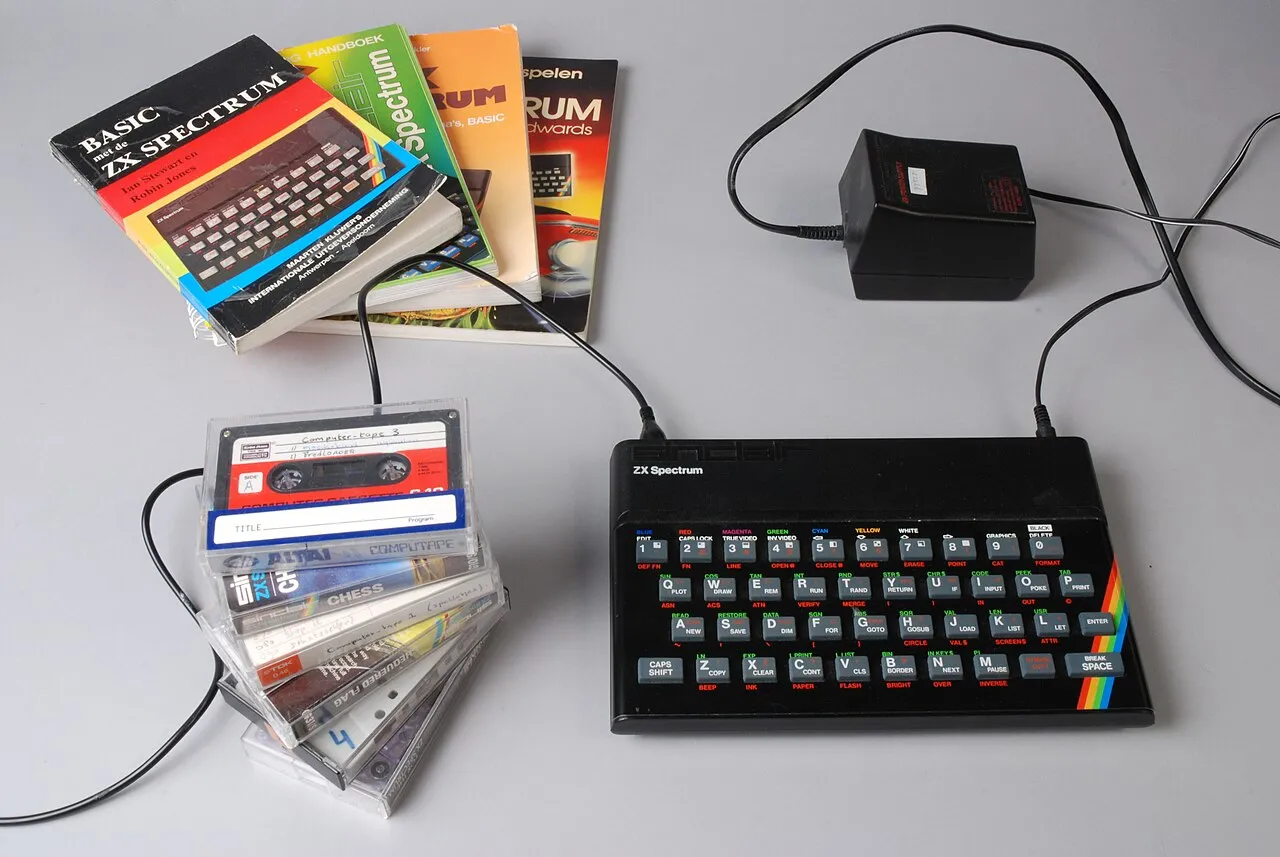
Covers and screenshots of the games themselves are under copyright, so we give verified facts and sources rather than images. The photo above is a freely-licensed illustration of how software was distributed: on cassette.
Platformer 1983
Manic Miner
Bug-Byte
One of the Spectrum’s most influential platformers, the work of a young Matthew Smith. The player guides the miner Willy through twenty caverns full of traps and moving monsters. It is remembered for its continuous in-game music — a rarity for games in 1983.
Platformer 1984
Jet Set Willy
Software Projects
The sequel to Manic Miner: a now-wealthy Willy must tidy his enormous mansion before going to bed. It was infamously released with a game-breaking bug, fixed by POKE codes printed in magazines. Dozens of interconnected rooms made it an early example of open-ended exploration.
System 1982
Sinclair BASIC
Sinclair Research
The Spectrum’s built-in language, baked into 16 KB of ROM. Keywords were entered with a single keypress — each key typed a whole token rather than letters. It was here that a whole generation first learned what programming was.
Space sim 1985
Elite
Firebird
Three-dimensional space trading and combat in wireframe graphics. The Spectrum port was released in 1985 by Firebird (the original was on the BBC Micro, 1984). The game had no fixed goal: the player chose their own path as trader, pirate or explorer of galaxies.
Arcade 1983
Chuckie Egg
A&F Software
Nigel Alderton’s classic platform arcade game: the player collects a dozen eggs on each level while dodging hens and running up ladders. One of the most widely ported British games of its time.
Text adventure 1982
The Hobbit
Melbourne House
Melbourne House’s illustrated text adventure based on Tolkien’s novel. Its “Inglish” parser understood full sentences, and characters acted on their own — the famous line “Thorin sits down and starts singing about gold”. A copy of the book itself came in the box.
Arcade adventure 1984
Knight Lore
Ultimate Play the Game
An arcade adventure by Ultimate Play the Game that popularised isometric graphics. The hero Sabreman turns into a werewolf at night and seeks a cure in a wizard’s castle. The action was drawn in monochrome — a deliberate way to avoid colour clash (attribute clash).
Strategy 1984
The Lords of Midnight
Beyond Software
Mike Singleton’s epic fantasy strategy: the player leads dozens of characters against the dark lord Doomdark. Its “landscaping” technique rendered thousands of different views of the game world. The blend of strategy and adventure made it one of the most ambitious titles of 1984.